Every Icelandic road sign that matters — and what to do at each
Decode the Icelandic road signs foreign self-drivers miss: einbreið brú, blindhæð, malbik endar and the F-roads — what each means and exactly what to do.
At a glance
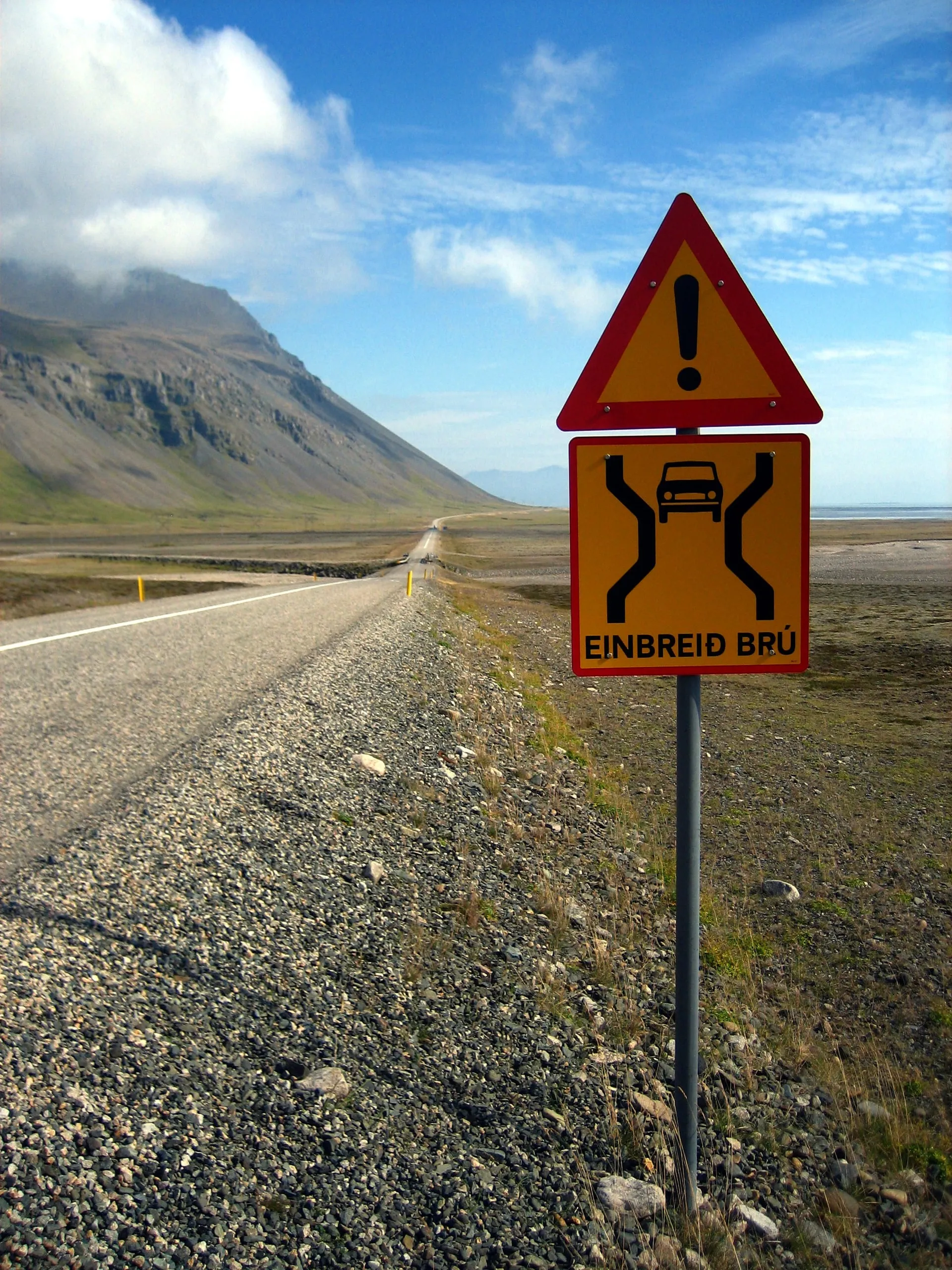
- Einbreið brú
- Single-lane bridge — slow right down and yield to the car already on or nearer it (no formal priority sign)
- Blindhæð
- Blind rise — oncoming traffic you cannot see over the crest; keep well right and slow
- Malbik endar
- Pavement ends, gravel begins — brake before the transition, the top loss-of-control point for visitors
- F-prefix (F26, F208)
- Highland mountain road — 4x4-only by law, often unbridged river fords, closed in winter
- Laus möl
- Loose gravel — flying stones crack windscreens; slow down and leave space from other cars
- Lokað / Ófært
- Closed / impassable — never drive past a closed gate
- Road numbers
- Route 1 = Ring Road; longer numbers = smaller and rougher; F = Highland
- Live status
- road.is / umferðin.is — never a date in an article
- Location
- Iceland
- Category
- safety
- Published
- 21 June 2026
- Updated
- 13 October 2026
Source summary
Every sign and term here is a real, documented Icelandic road sign or road-status word used by Vegagerðin (the Icelandic Road Administration) and road.is/umferðin.is. Meanings are described generically; this article never states any specific road's current open or closed status — that is only ever on the live road.is map, which we link.
Why do Iceland’s road signs catch foreign drivers out?
Because the ones that matter most are words, not symbols. Back home you read a pictogram at a glance; here the warning is spelled out in Icelandic — einbreið brú, blindhæð, malbik endar — and if you don’t know the word, you drive straight past the instruction.
None of these are exotic. They mark the three situations that cause the most single-vehicle crashes for visitors: a bridge only one car wide, a rise that hides oncoming traffic, and the point where pavement turns to gravel. Learn six or seven Icelandic words and the road stops ambushing you.
This piece decodes the signs and route numbers a foreign self-driver actually needs. It does not tell you any specific road’s status today — that lives on road.is, which we link at the end.
Einbreið brú — what a single-lane bridge sign means
Einbreið brú means single-lane bridge — a bridge only wide enough for one car. Iceland has hundreds, and they are not confined to back roads: several sit on the paved Ring Road, especially on the stretch east of Vík toward Höfn.
Here is the part visitors get wrong: there is no priority sign and no right-of-way arrow. The convention is simply that whichever car reaches the bridge first crosses, and the other waits on its side. That works only if both drivers slow down and read the situation early.
What to do:
- Lift off the throttle as soon as you see the sign — you should arrive slow, not braking hard on the deck.
- Yield to any car already on the bridge, or clearly closer to it. Never accelerate to get there first.
- If in doubt, stop and wave them through. A ten-second wait costs nothing; two cars meeting mid-bridge is a head-on.
Blindhæð — the blind-rise sign
Blindhæð means a blind rise — a crest steep enough that you cannot see oncoming traffic on the far side until you are over it. On Iceland’s narrower and gravel roads, drivers drift toward the middle, and a blind rise is exactly where two mid-road cars meet.
The rule is simple: keep well to the right and slow down as you approach the crest. Assume there is a car coming that you cannot yet see, because often there is. The same word appears as blindbeygja for a blind bend — same instinct, keep right and ease off.
Malbik endar — where the pavement ends and the gravel starts
Malbik endar means the asphalt ends. You may also see bundið slitlag endar (sealed surface ends). Either way, you are about to leave smooth pavement for loose gravel — and this is the single most dangerous transition on an Icelandic road for a foreign driver.
Why it’s dangerous: hit gravel at highway speed and the loose surface grabs the tyres, the back of the car steps out, and the instinctive over-correction rolls it. This is the classic Iceland single-vehicle rollover, and it happens right at the sign.
What to do: brake on the pavement, before the gravel, not on it. Get your speed down while you still have grip, then treat the gravel as a slower, looser road until the next malbik or bundið slitlag sign tells you the seal is back.
F26, F208 — what the F on a road sign means
An F before the number — F26, F208, F35 — marks a fjallvegur, a Highland mountain road. The F is not decoration; it is a legal category:
- 4x4 only, by law. A 2WD car is illegal on an F-road and uninsured the moment it turns on — rental agreements are unanimous on this.
- Gravel, with river fords. Many F-roads cross unbridged rivers you must drive through; depth changes daily with weather and meltwater.
- Closed in winter. They open in stages in early summer, only after Vegagerðin inspects each one. See when the F-roads open for the sequence.
If your car is a normal 2WD and the sign has an F, that road is not for you. Turn around.
Laus möl, sheep, wind and rivers — the warning signs
The yellow diamond warning signs are more familiar in shape, but the Icelandic text still carries the specifics:
- Laus möl — loose gravel/chippings. Flying stones chip paint and crack windscreens. Slow down and leave a big gap from the car ahead and from oncoming traffic; a gravel-chip claim is the most common rental damage here.
- Sheep (búfé) on the road. Free-roaming all summer and autumn, and they bolt without warning — often one crosses and its lamb follows from the other side. Slow, don’t swerve.
- Strong wind (hvassviðri). Gusts can push a car across a lane and rip a door out of your hand at a stop. Grip the wheel, and point the car into the wind before opening any door.
- Unbridged river (óbrúuð á) / ford (vað). A Highland-only sign. Never enter a river you haven’t checked on foot, and never in a 2WD.
Lokað, Ófært and the winter signs
Two words to know cold:
- Lokað — closed. On a gate or barrier, the road is shut. Driving past is illegal, voids your insurance, and leaves you paying the full cost of recovering the car yourself.
- Ófært — impassable. The road is not driveable in current conditions.
On the road.is map you’ll also meet Þungfært (heavy going / difficult), Hálka or Hált (ice / slippery), and winter symbols (a snowflake) flagging snow and winter-service state. These are live statuses, not fixed signs — which is exactly why you check the map on the day rather than trusting any schedule.
How does the Icelandic road-number system work?
The number on the sign tells you roughly what kind of road you’re about to drive:
- Route 1 — the Hringvegur (Ring Road). The paved loop around the island; the backbone of almost every trip.
- Two-digit numbers — primary roads. Mostly paved, though some stretches are gravel.
- Three-digit numbers — smaller local roads. More likely to be gravel the longer they get.
- F-prefix — Highland mountain roads. Gravel, 4x4-only, seasonal.
The rule of thumb: the longer the number, the smaller and rougher the road; an F means Highland. It’s a guide, not a guarantee — a few numbered roads are gravel and a few are surprisingly good — so confirm the surface and status on road.is before you commit.
Where do you check if a road is open right now?
Three official sources, in order:
- road.is (also umferðin.is) — the live map. Continuously updated: open, closed (lokað), impassable (ófært), heavy going, and mountain-vehicle-only, with winter symbols. This is the authority for any specific road’s state right now.
- SafeTravel — safety advice and a 90-second trip plan before any Highland or remote drive.
- The morning-of weather on Veður.is — wind is the limiting factor on many Icelandic roads, and a clear road can turn to white-out in hours.
For the fuller how-to, see how to check road conditions.
The safety bottom line
Three signs cause most of the trouble for foreign drivers, and they’re all about speed and position, not skill:
- Malbik endar — brake before the gravel, not on it.
- Einbreið brú — arrive slow, yield to the car already there, never race the bridge.
- Blindhæð — keep right and ease off over every crest.
Learn those three Icelandic phrases and you’ve removed the most common ways a self-drive trip here goes wrong. Everything else — the F-roads, the sheep, the wind — you now have the words for too. Check road.is the morning you drive, and let the signs do their job.
See also
- Do you need extra rental-car insurance in Iceland? — what gravel, wind and river damage actually cost you
- Iceland road conditions — what’s open, what’s weather-dependent, and the live map
- When Iceland’s Highland F-roads open — the opening sequence and the river-crossing detail
- The South Coast route — gravel turnoffs, single-lane bridges and wind on Route 1
- Vík to Höfn — the Ring Road stretch with the most single-lane bridges
- 7 days on the Ring Road — the classic loop where you’ll meet every sign here
- Iceland in June — the start of Highland season
Frequently asked questions
What does "einbreið brú" mean, and who goes first?
Einbreið brú means single-lane (single-width) bridge, and Iceland has hundreds of them, including on the paved Ring Road east of Vík. There is no priority sign and no right-of-way arrow — the convention is that whichever car reaches the bridge first crosses, and the other waits. In practice: lift off early, be ready to stop, and yield to any car already on the bridge or clearly closer to it. Never race to beat an oncoming car onto it. If in doubt, stop on your side and wave them through.
What does an F-road sign mean, and can I drive one in a normal car?
An F before the number (F26, F208, F35) marks a fjallvegur — a Highland mountain road. By Icelandic law these are 4x4-only, and rental agreements void all insurance for a 2WD car on them. They are gravel, often have unbridged river crossings you must ford, and are closed through winter, opening only after Vegagerðin inspects them in early summer. If your car is a normal 2WD, an F on the sign means that road is not for you — turn around.
What does "malbik endar" mean, and why is it dangerous?
Malbik endar means the asphalt ends — you are about to leave sealed pavement for loose gravel (you may also see bundið slitlag endar, sealed surface ends). It matters because hitting gravel at highway speed is the classic foreign-driver crash: the loose surface grabs the tyres, the back steps out, and an over-correction rolls the car. Brake before the transition, not on it, and treat the gravel as a slower, looser road the moment the pavement stops.
What do "Lokað" and "Ófært" mean on Icelandic road signs?
Lokað means closed and Ófært means impassable. You will see them on gates and barriers and as status words on the road.is map. A closed gate is closed for a reason — snow, mud, flooding or an unsafe river — and driving past one is illegal, voids your insurance, and leaves you paying the full cost of recovering the car yourself. You may also meet Þungfært (heavy going / difficult) and Hálka or Hált (ice / slippery). Treat all of them as instructions, not suggestions.
How does the Icelandic road-number system work?
Route 1 is the Hringvegur, the paved Ring Road around the island. Two-digit numbers are primary roads (mostly paved, some gravel); longer three-digit numbers are usually smaller, local and more likely to be gravel; and an F-prefix means a Highland mountain road. The rough rule: the longer the number, the smaller and rougher the road, and an F means 4x4-only Highland. It is a rule of thumb, not a guarantee — always confirm the surface and status on road.is.
Where do I check whether an Icelandic road is open right now?
The official live map is road.is (also reachable as umferðin.is), updated continuously with closures, surface state and winter symbols. For safety advice and to file a trip plan before a Highland or remote drive, use SafeTravel. Never take a road's open or closed status from a date in an article — including this one — because it changes hour to hour. Check the live map the morning you drive.