How to read Icelandic place names (and pronounce a few)
Icelandic place names are a map legend in disguise — -foss is a waterfall, -jökull a glacier, -vík a bay. Learn the endings and read the map.
At a glance
- What the endings are
- Suffixes that name the landscape — foss (waterfall), jökull (glacier), vík (bay), fjörður (fjord)
- More endings
- dalur (valley), nes (headland), ey/eyjar (island/s), á (river), vatn (lake), hver (hot spring)
- Terrain endings
- fell/fjall (mountain), sandur (black-sand plain), hraun (lava field), bær (farm/town)
- Names stack together
- Jökulsárlón = jökull + á + lón, a "glacier-river lagoon"
- Common first parts
- Reykja- (smoky), Blá- (blue), Svart- (black), Gull- (golden), Ís- (ice)
- The tricky letters
- þ = "th" in thing, ð = "th" in this, j = "y", ll is roughly "tl"
- Stress rule
- Always on the first syllable of an Icelandic place name
- Why it helps
- You can read the terrain off the map before you arrive
- Location
- Iceland
- Category
- editorial
- Published
- 13 August 2026
- Updated
- 13 August 2026
Source summary
Evergreen explainer based on standard Icelandic place-name elements (örnefni) and pronunciation, drawing on the National Land Survey of Iceland and the Árni Magnússon Institute for Icelandic Studies. No live event.
Why do Icelandic place names describe the landscape?
Because the settlers named things for exactly what they were. A waterfall was a foss, a glacier a jökull, a bay a vík — so the name is really a label stuck on the map. Once you know a dozen of these endings, Iceland stops looking like a wall of consonants and starts reading like a description of what is actually there.
That is genuinely useful on the road. See -jökull on a sign and you know there is ice ahead; see -sandur and you are about to cross a flat black-sand plain; see -fjörður and the road is probably about to wind a long way around water.
What do the common Icelandic name endings mean?
These are the ones you will actually meet on the Ring Road, each with a real example:
| Ending | Means | Example |
|---|---|---|
| -foss | waterfall | Skógafoss, Gullfoss |
| -jökull | glacier | Vatnajökull, Snæfellsjökull |
| -vík | bay, cove | Vík, Reykjavík |
| -fjörður | fjord | Seyðisfjörður, Ísafjörður |
| -dalur | valley | Laugardalur |
| -nes | headland, peninsula | Stokksnes, Reykjanes |
| -ey / -eyjar | island / islands | Vestmannaeyjar, Flatey |
| -á | river | Jökulsá, Þjórsá |
| -vatn | lake | Mývatn, Þingvallavatn |
| -hver | hot spring | Hveragerði |
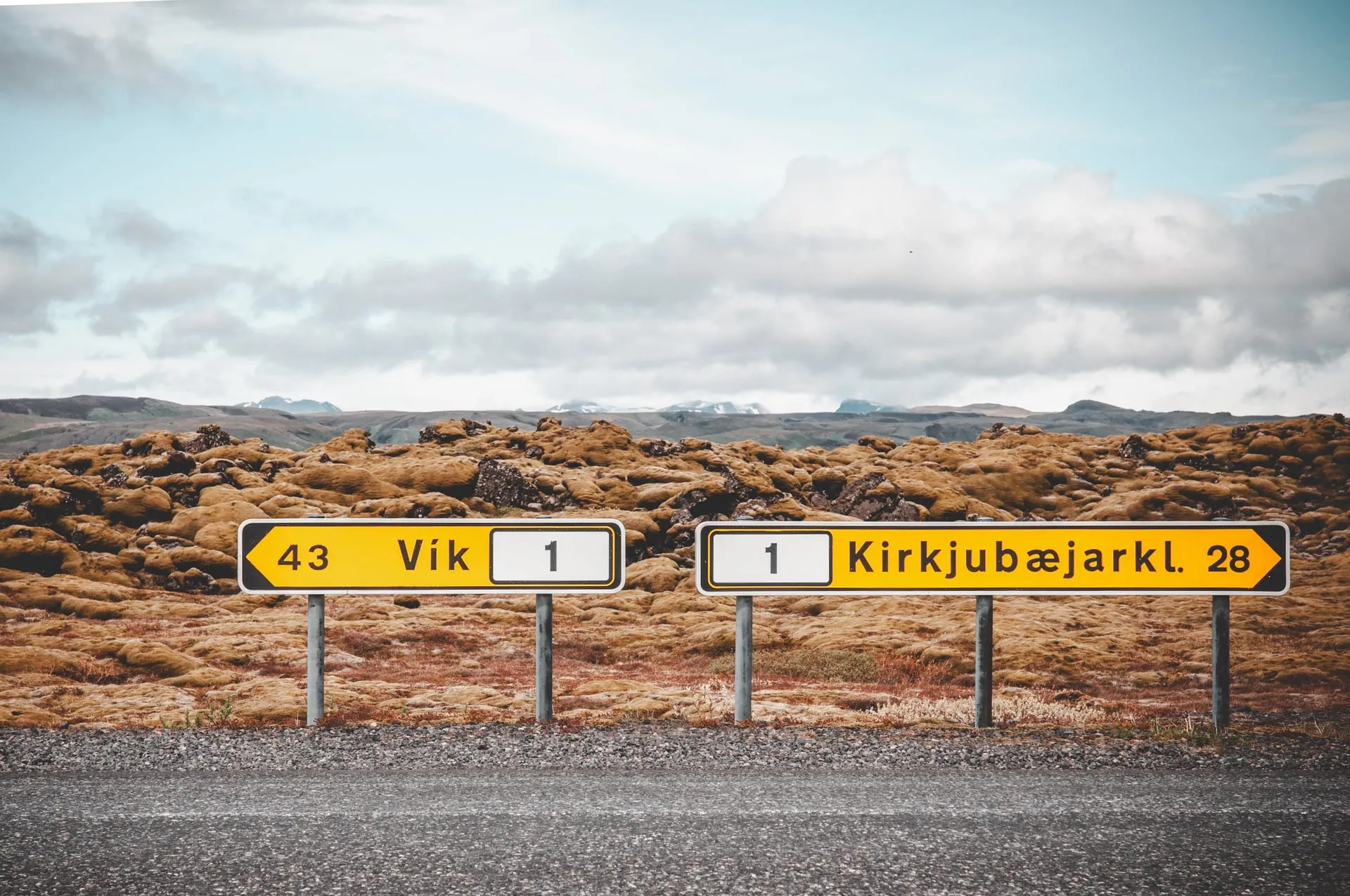
| -bær | farm, town | Kirkjubæjarklaustur, Garðabær |
| -fell / -fjall | mountain | Skaftafell, Kirkjufell |
| -sandur | black-sand plain | Sólheimasandur, Skeiðarársandur |
| -hraun | lava field | Eldhraun |
The endings also stack. Jökulsárlón is jökull + á + lón (lagoon) — a “glacier-river lagoon”, which is precisely what it is. And on the coast you will meet -fjara (beach), as in Reynisfjara.
What does the first part of the name tell you?
The front of the word usually adds a colour or a feature. A few repeat everywhere:
- Reykja- means “smoky” or “steamy” (from reykur, smoke). Reykjavík is literally “smoky bay” — the settlers named it for the steam rising off the hot springs.
- Blá- means “blue.” Bláfjöll, the ski hills above the capital, are the “blue mountains”; Bláa lónið is simply “the blue lagoon.”
- Svart- means “black.” The basalt-column waterfall Svartifoss, up in Skaftafell, is the “black waterfall.”
- Gull- means “golden” (Gullfoss, and the Gullni hringurinn — the Golden Circle).
- Ís- means “ice” (Ísafjörður, “ice fjord”).
Put the two halves together and most names explain themselves: Reykja + nes is “smoky peninsula”, Mý + vatn is “midge lake”, Svarti + foss is “black waterfall.”
How do you pronounce the letters you don’t recognise?
You do not need to sound Icelandic — just close enough to be understood. Five things get you most of the way:
- þ (“thorn”) is the “th” in thing — Þingvellir is roughly “THING-vet-lir.”
- ð (“eth”) is the softer “th” in this or breathe, and it never starts a word (Seyðisfjörður).
- j is a “y” — jökull sounds like “YÖ-kutl”, Reykjavík like “RAYK-ya-veek.”
- ll is usually a “tl” sound, which is why Eyjafjallajökull tripped up every news anchor in 2010 (“AY-ya-fyat-la-YÖ-kutl”).
- Stress always lands on the first syllable. Every time.
The accented vowels are separate letters, not louder versions of the plain ones: í/ý = “ee” (Vík = “veek”), ú = “oo” (Húsavík), ó = “oh”, á = “ow” as in cow, ö = the “u” in fur, and æ = “eye.” Get those and a local will know which waterfall you mean.
How does reading the names make trip planning easier?
It tells you what a place is before you have opened a single photo. Scanning a route, you can read the terrain straight off the map:
- A run of -foss names means waterfall country — that is most of the South Coast, from Seljalandsfoss to Skógafoss.
- -jökull and -sandur together — as around Skaftafell and Jökulsárlón — mean glaciers and flat outwash plains: big, cold and exposed.
- -vík, -nes and -fjörður mean coast: bays, headlands and the long drives around fjords.
So when you are mapping out a day in, say, July, the names do half the sorting for you, and you can guess what waits at each stop without a guidebook. For the wider list of what earns a stop, see things to do in Iceland.
See also
- Skógafoss and Seljalandsfoss — the classic -foss pair on the South Coast
- Jökulsárlón — jökull + á + lón stacked into one name
- Vík and Stokksnes — a -vík and a -nes you can stand on
- The South Coast route and Iceland in July
Frequently asked questions
What does -foss mean in Icelandic place names?
Foss means waterfall. So Skógafoss is 'Skógar waterfall', Gullfoss is 'golden waterfall', and any name ending in -foss marks a waterfall you can usually reach from the road or a short walk.
What do the endings -vík, -fjörður and -nes tell you?
They are all coastal. Vík is a bay or cove (Reykjavík, 'smoky bay'), fjörður is a fjord (Seyðisfjörður) and usually means a long drive around water, and nes is a headland or peninsula (Reykjanes, where the airport sits).
How do you pronounce þ and ð?
þ (thorn) is the 'th' in 'thing'; ð (eth) is the softer 'th' in 'this' or 'breathe', and it never starts a word. Stress always lands on the first syllable, so Þingvellir is roughly 'THING-vet-lir'.
Do I need to speak Icelandic to read the map?
No. Learning about a dozen endings — foss, jökull, vík, fjörður, dalur, nes, á, vatn, fell, sandur — is enough to guess what most places are before you arrive. Your pronunciation only has to be close enough to be understood.