Northern lights season is here — how to actually see them in Iceland
Northern lights season in Iceland runs late August to mid-April. How to read the Veður.is forecast, why cloud cover matters most, and where to look.
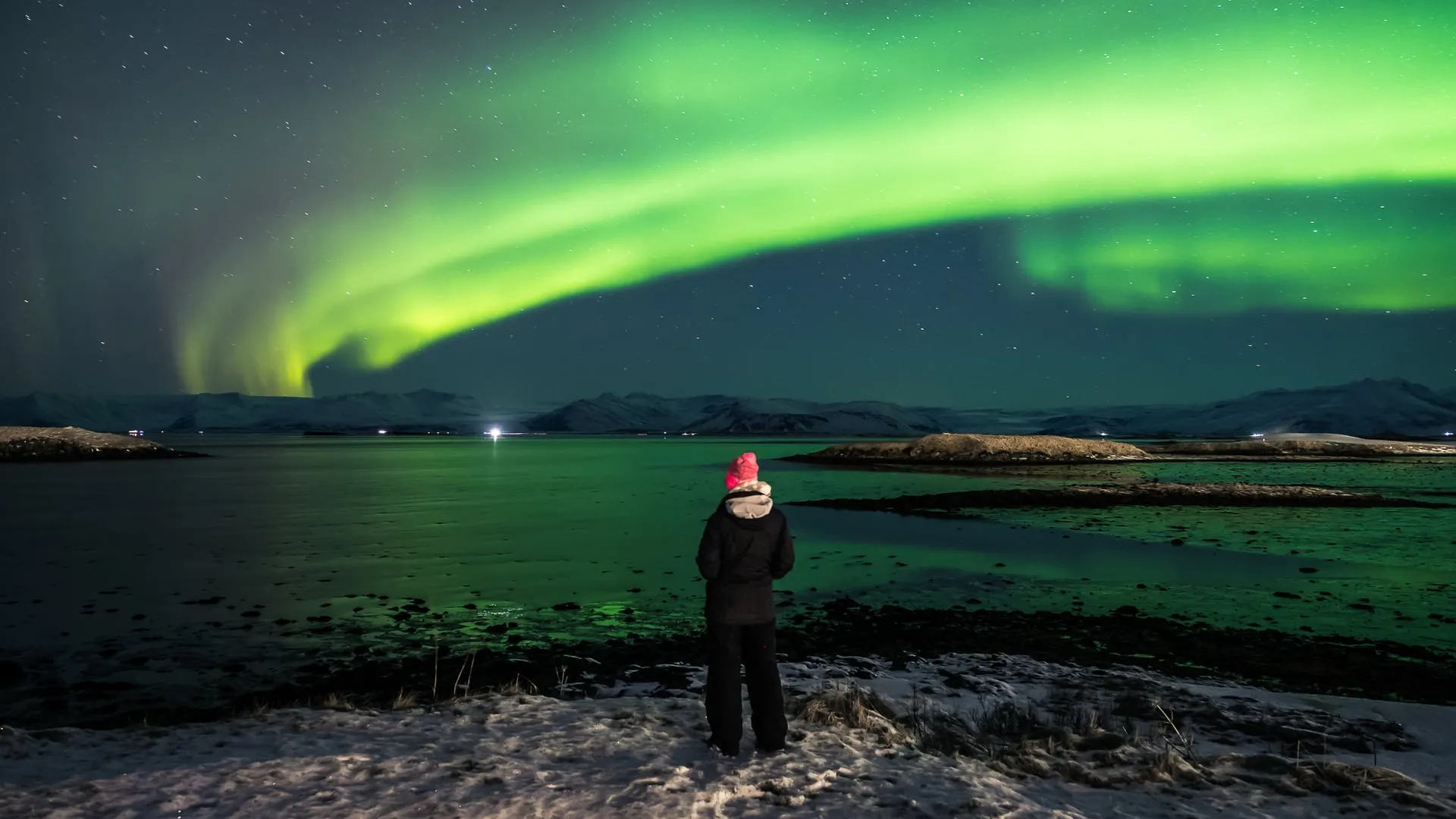
At a glance
- Season
- Roughly late August to mid-April; darkest October–March
- What you need
- Darkness + clear sky + solar activity, all at the same time
- Live forecast
- Veður.is aurora forecast (cloud map + 0–9 activity scale)
- Read first
- Cloud cover (white = clear sky), then the activity number
- Activity worth a drive
- 2 or more, if the sky is clear
- Best hours
- Roughly 21:00–02:00, once it is fully dark
- Where
- Away from town lights, wherever the cloud map shows clear sky
- Guaranteed?
- No — nobody can promise a sighting; plan several nights
- Cost
- Free if you drive yourself
- Location
- Iceland
- Category
- attraction
- Published
- 20 October 2026
- Updated
- 20 October 2026
Source summary
Evergreen explainer based on local experience and the Icelandic Met Office (Veður.is): its aurora forecast page, the forecast's help notes and its space-weather page. No live event and no activity forecast; check the live Veður.is map on the night.
The bright summer nights are over and the northern lights season is in full swing. Seeing them is not luck. It comes down to three conditions lining up on the same night, and one free forecast shows you when they might. This is how we read it, and what to do once it says go. For the full background, see our northern lights guide.
What does it take to see the northern lights?
Three things, all at the same time:
- Darkness. A real night sky, away from streetlights. Iceland’s season runs roughly from late August to mid-April; outside that window the summer nights are too bright. The deepest darkness and longest viewing nights are October to March, which is why October and November are strong months.
- A clear sky. The aurora happens at least 100 km up, far above the weather. Thick cloud between you and it means you see nothing.
- Solar activity. Charged particles from the Sun hitting the upper atmosphere. Iceland lies under the auroral oval, the ring of activity around the magnetic pole, so it doesn’t take a big solar storm.
Miss any one and the night is a blank. Get all three and even a modest night can be worth the cold.
How do you read the Veður.is aurora forecast?
The Icelandic Met Office’s aurora forecast is free, and in winter it’s the page we check every evening. Read it in this order.
Start with the cloud map
The big map of Iceland is a cloud forecast. The key: green is cloud, white is clear sky. White near you is what you want.
Move the slider under the map through the evening and watch where the white patches drift. Cloud moves fast here, so the gap at 22:00 may not be where it was at 18:00. The map has low, middle and high cloud layers plus a composite; start with the composite. Thin high cloud dims a display; thick low cloud blocks it completely.
Then the 0–9 activity number
The box in the upper right gives expected aurora activity on a 0–9 scale for around midnight on the date you’ve picked. It’s the same range as the Kp index used in space-weather forecasts. In practice:
- 0–1: quiet. Faint arcs are still possible on a very dark, clear night, so look outside anyway.
- 2–3: a normal good night in Iceland. The Met Office’s own help notes say even a 2 can be beautiful and a 3 dazzling.
- 4 and up: strong, and much rarer. Veður.is puts the global Kp index at 0–4 about 90% of the time, so if you wait for a 5 you may wait all trip.
The honest rule: a 2 or 3 under clear sky beats a 5 under solid cloud, every time. Cloud first, number second.
Treat it as a guide, not a promise
Activity forecasts only firm up a day or so ahead. The solar wind takes roughly one to three days to reach Earth, so a number for five nights out is a rough guide; re-check on the night. The Sun and Moon panel on the same page gives darkness and moonrise times for Reykjavík. A bright moon washes out a faint aurora, though a strong one still shows.
When and where should you look?
- When: once it’s fully dark. The most productive stretch is usually around 21:00–02:00, but the aurora can show any time the sky is dark. In late August and September darkness arrives later, so check the darkness time first.
- Where: away from town lights. Even a village’s streetlights cost you the fainter displays. Park in a proper car park or pull-out, never on the road or its narrow shoulder: in the dark, the driver behind you is looking at the sky too. Headlights off once you’re parked.
- Which way: start by scanning north, but in Iceland the aurora often arcs right overhead or even to the south.
- Your eyes: give them about 20 minutes in the dark. Every glance at a bright phone screen resets the clock, so turn the brightness right down.
- Patience: displays come in bursts. A faint arc can sit there for an hour, then flare across the sky for ten or twenty minutes and fade again. Give it at least an hour before you call it.
What will you actually see?
Probably less colour than the photos. Your eyes see little colour in the dark, so a faint aurora often looks like a grey-green or whitish band, often low in the north and easy to mistake for thin cloud. That band is the aurora starting. Don’t drive off.
A camera collects light over several seconds, so it records the green (and sometimes pink or purple) your eyes miss. The quick test: photograph the band on your phone’s night mode, propped on something steady. If the “cloud” turns green on screen, it’s the aurora. Strong displays do show green to the naked eye, and move fast enough to watch.
Nobody can promise a sighting: not us, not a tour, not a hotel with an aurora wake-up call. Plan at least three nights, and ignore “tonight!!” social posts. Check the forecast yourself.
How should you dress for an aurora night?
For standing still in the cold, which is harder than walking in it. The clear nights you want are the coldest ones, because there is no cloud blanket to hold the day’s warmth in. A still, clear October night can drop below freezing even after a mild day.
- A thermal base layer and a warm fleece or down mid-layer
- A windproof, waterproof shell on top, for the same reason there are no umbrellas in Iceland: the wind
- A hat, warm boots, and gloves (thin liner gloves let you work a camera)
- Ice cleats for slippery car parks, and a thermos of something hot
How do you chase a clear sky?
Check the cloud map region by region, not just where you’re staying. Iceland’s weather is regional: one side of the country can sit under cloud while another is clear. A local rule of thumb: in a northerly wind the south side of the island is often clearer, and in a southerly the north and east tend to clear. The map decides, though, not the rule.
Then drive to the gap. Sometimes 30 minutes is all it takes. Before you set off on a winter night, check road.is for road conditions and Veður.is for wind warnings; our guide to checking road conditions in Iceland walks through both, and Iceland in winter covers the driving basics. If the only clear sky is three hours away over a mountain pass, let it go. Another night will come.
Can you see the northern lights from Reykjavík?
Yes, on strong nights. The usual city spot is the Grótta lighthouse on Seltjarnarnes, at Reykjavík’s western tip, where the sea gives you a dark horizon. But city light washes out the fainter displays, so on an ordinary 2–3 night you’ll see far more after a 20–30 minute drive out of town. Þingvellir National Park, about 45 minutes away, is the classic dark-sky run from the capital.
Staying outside the capital? Same rule, smaller scale: a few minutes past the last streetlight is usually enough. For shots with a foreground, our photography stops run from Jökulsárlón to Stokksnes.
What should you do tonight if you’re already in Iceland?
- Open the Veður.is aurora forecast. Cloud map first: look for white near you between 21:00 and 02:00.
- Check the activity number. If it’s 2 or more and the sky will be clear, go.
- Check darkness and moonrise in the Sun and Moon panel.
- Driving? Check road.is and the Veður.is warnings first.
- Dress for standing still: layers, hat, gloves, cleats.
- Head for the clear patch, park off the road, lights off.
- Give your eyes 20 minutes and the sky at least an hour.
See also
- Northern lights in Iceland — the full guide: season, conditions, tours
- Photography stops — foregrounds for aurora shots
- Iceland in October and Iceland in November — two strong aurora months
- Iceland in winter — the full-season overview
- Why there are no umbrellas in Iceland — dressing for wind and cold
- How to check road conditions in Iceland
- Live: Veður.is aurora forecast
Frequently asked questions
What Kp index do you need to see the northern lights in Iceland?
Less than most people think. Iceland lies under the auroral oval, so a 2 or 3 on the Veður.is 0–9 activity scale (the same range as the Kp index) can give a good show if the sky is clear. The Met Office's own help notes say even a 2 can be beautiful. Cloud matters far more than the number: a 2 under clear sky beats a 5 under solid cloud.
Can you see the northern lights from Reykjavík?
Yes, on strong nights. The usual city spot is the Grótta lighthouse on Seltjarnarnes, at Reykjavík's western tip. But streetlights wash out the fainter displays, so you will see far more after a 20–30 minute drive out of town to somewhere dark and clear.
Are northern lights sightings guaranteed in Iceland?
No, and be wary of anyone who says otherwise. You need darkness, clear sky and activity at the same moment, and even a strong forecast fails under cloud. Plan at least three nights, check the Veður.is forecast each evening, and treat a sighting as a bonus rather than a booking.
Why do the northern lights look grey instead of green?
Because your eyes see little colour in the dark. A faint aurora often looks like a grey-green or whitish band, easy to mistake for thin cloud, while a camera collects light over several seconds and shows it vivid green. Strong displays do look green to the naked eye. Quick test: photograph the band with your phone, and if it turns green on screen, it's the aurora.
What time are the northern lights best in Iceland?
Roughly 21:00 to 02:00, though they can appear any time the sky is properly dark. Early and late in the season darkness starts later, so check the darkness time in the Sun and Moon panel on the Veður.is aurora page. Activity comes in bursts, so plan to stay out an hour or two.
Is a northern lights tour worth it?
Worth it if you don't have a car or don't want to drive icy roads at night: the guide reads the cloud forecast and drives to the clear patches for you, and many operators offer a free retry if you see nothing (check the terms before booking). With a car, the Veður.is map lets you do the same thing for free.