When do Iceland's F-roads close for winter — and what opens instead?
When do Iceland's F-roads close? In stages through September and October as snow arrives. The typical order, what closed means and what opens instead.
At a glance
- Authority
- Vegagerðin (Icelandic Road Administration)
- Live status
- road.is / umferdin.is, or call 1777 (24 hours)
- SafeTravel guidance
- F-roads usually closed from mid-September until June or July
- Typically first to close
- Askja (F88, F910) and Sprengisandur (F26)
- Typically last to close
- F35 Kjölur
- Winter access
- Guided super-jeep tours only (modified vehicles, experienced drivers)
- Location
- Iceland
- Category
- road
- Published
- 13 October 2026
- Updated
- 13 October 2026
Source summary
This piece describes the typical autumn closing pattern of Iceland's F-roads, drawing on SafeTravel's Highland driving guidance and Vegagerðin's published mountain-road procedure. It never states any specific road's current open or closed status. That lives only on the live road.is / umferdin.is map and SafeTravel, which we link.
Why is there no fixed closing date?
Because snow decides, not the calendar. In spring, Vegagerðin (the Icelandic Road Administration) opens each F-road only after inspecting it. In autumn it runs the other way: the roads go one at a time as snow settles on hálendið, the Highlands, and the change shows up on the live road.is map. F-roads aren’t kept clear in winter, so once a route is snowed in, it stays shut until the spring melt.
SafeTravel’s planning line is blunter. Its Highland driving guidance describes the F-roads as usually closed from mid-September until June or July, and impassable in that window for anything but a modified super-jeep with an experienced driver. In a mild autumn a lower route can stay drivable into October. That is something to confirm on the day, not something to build a trip around.
Which F-roads close first, and which hold out longest?
Roughly the spring opening order in reverse: the same snow and altitude, run backwards. The routes that open last, in July, are usually the first to go in autumn. The easy crossing that opens first in late May tends to be the last to close.
This is the pattern in most years, not this year’s status. A specific road’s state today is only on the live map.
Usually first to go: the remote interior
- F88, F894 and F910 to Askja — the high north-eastern interior around the Dyngjufjöll caldera, plus the long eastern route toward Kverkfjöll. Snow comes early up here, and the fords on the F88 approach swell after autumn rain.
- F26 Sprengisandur — Iceland’s longest Highland traverse, north to south across the exposed middle of the island. Often impassable by late September or early October.
Next: Fjallabak and Þórsmörk
- F208, F225 and F210 (Fjallabak) — the routes to Landmannalaugar and Eldgjá. In most years they go in late September or October, as the first lasting snow settles.
- F249 Þórsmörk — the valley sits low, so the river crossings matter more than the snow, the Krossá above all. Outside summer this is super-jeep territory.
Usually last: Kjölur
- F35 Kjölur — the dry route between Langjökull and Hofsjökull, with no real fords on the main line. Usually the first F-road to open in spring, it tends to be among the last to become impassable, and in a mild year it can hang on well into October.
By late October, in most years, the central Highlands are effectively shut to self-drivers until the snow melts: late May at the earliest for Kjölur, July for Askja and Sprengisandur.
What does “closed” actually mean on an F-road?
Three things at once:
- Impassable. Snow can bury the track entirely, and a standard rental 4x4 isn’t built for deep snow or winter fords.
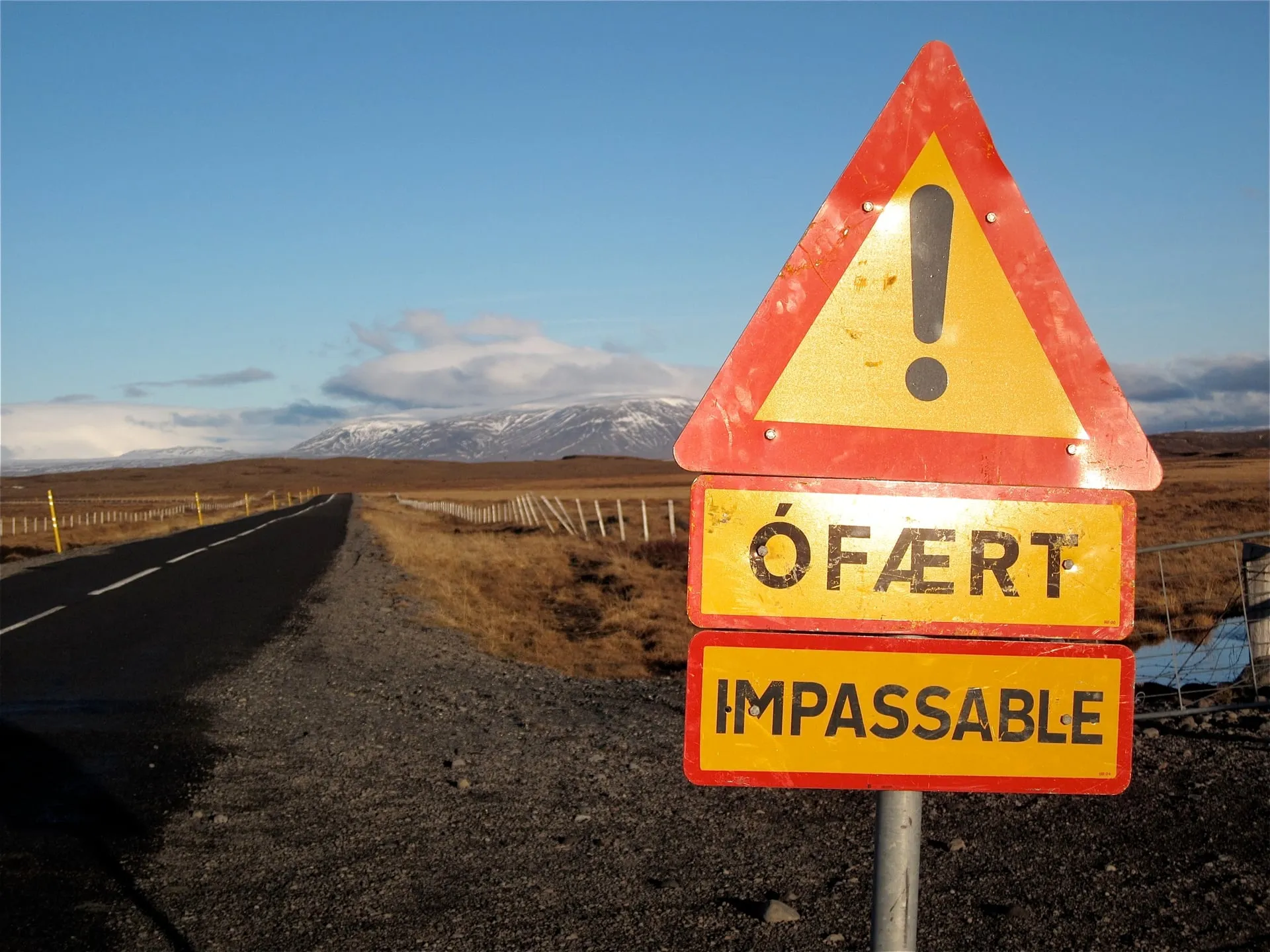
- Illegal. Lokað (closed) on a sign or barrier means exactly that, and driving past it is against the law. Steering around a barrier onto open ground is off-road driving, which is separately illegal and heavily fined. Ófært (impassable) on the map means the road can’t be driven in current conditions. Don’t test it.
- Uninsured. Rental agreements typically exclude closed roads (read yours), and SafeTravel is explicit that no insurance covers damage from crossing a river.
If you get stuck and you’re in danger, call 112 and ICE-SAR, Iceland’s volunteer search-and-rescue teams, will come out. Getting the car itself out of a drift or a river in the interior is a private recovery job, and with your cover void, that bill lands on you.
The sign words are decoded in Icelandic road signs explained. What your cover does and doesn’t include off the paved roads is in rental-car insurance in Iceland.
I’m in Iceland now — can I still drive to Landmannalaugar or Þórsmörk?
If you’re reading this in October or later, plan on no, at least not by rental car. SafeTravel describes the F-roads as usually closed from mid-September, and in most years snow has reached Fjallabak by mid-to-late October. If a route still shows as passable on road.is, treat it as the tail of the season, not a plan.
Late-season Highland driving also runs into something people forget: light. October loses daylight fast, from around 11 hours at the start of the month to about 8 by the end, so a long F-road day can run out of light before it runs out of road. Fewer cars on the route also means help is further away.
The practical move is to take the Highlands off this trip and swap in what autumn does better.
Can you visit the Highlands in winter at all?
Yes, but not in a rental car. For the closed season, SafeTravel’s advice is to book a modified vehicle with an experienced driver. In practice that means a guided super-jeep tour with a licensed operator, on oversized tyres, with someone who knows the routes in snow.
Is it worth it? If the snow-covered interior is the point of your trip, yes: it’s the only legitimate way in. If you mainly want Landmannalaugar’s coloured rhyolite mountains, those are a summer sight, because snow covers the colour. Come back for them in July.
What opens when the Highlands close?
The honest upside: autumn and winter Iceland isn’t a lesser version of the summer trip. It’s a different one, and several of its best things only exist now.
- Natural ice caves. New-season tours under Vatnajökull typically start from late October, once operators have scouted caves that are safe, and run through the winter. Guided only. See ice cave tours.
- Northern lights. The nights are properly dark again, and October and November are strong aurora months. You need clear skies and some activity; the cloud forecast on Veður.is is the one to watch. See northern lights in Iceland.
- The winter South Coast. Seljalandsfoss, Skógafoss, Reynisfjara and Jökulsárlón sit on or just off the paved Ring Road and are far quieter than in summer. Drive the South Coast route in daylight and keep a buffer day for wind.
- Hot water in cold air. Geothermal pools and hot springs run all year and are at their best with frost on the ground.
Month by month, Iceland in October covers the month the Highlands close and the ice caves start, and Iceland in November is winter proper. For the whole season, read Iceland in winter.
How do you check whether a specific F-road is open today?
Never from an article, this one included. Use the live sources the morning you drive:
- umferdin.is / road.is — Vegagerðin’s live map, with every road’s current status, F-roads included. To ask a person, call Vegagerðin’s 24-hour line on 1777.
- SafeTravel — alerts, Highland guidance, and a travel plan you can leave before any remote drive.
- Veður.is — wind and snow warnings. In autumn the weather closes roads faster than any calendar.
Don’t let a sat-nav or map app route you across the interior. They don’t always know a Highland road is closed; the live map does. Our guide to checking road conditions in Iceland walks through all three sources, and What to do in Iceland today carries a live road-status summary.
When do the F-roads open again?
Next spring, in stages, as the snow melts and Vegagerðin inspects each road. Typically Kjölur (F35) goes first in late May or early June, Landmannalaugar and Þórsmörk follow from mid- to late June, and Askja and Sprengisandur come last, in early to mid-July. The full sequence, and how to catch the day each one opens, is in when Iceland’s Highland F-roads open.
See also
- When Iceland’s Highland F-roads open — the spring sequence this autumn pattern mirrors
- How to check road conditions in Iceland — road.is, Veður.is and SafeTravel in detail
- Icelandic road signs explained — Lokað, Ófært and the F-prefix decoded
- Do you need extra rental-car insurance in Iceland? — what your cover excludes off the paved roads
- Iceland in October — the month the Highlands close and the ice caves start
- Iceland in November — winter proper, with every F-road closed
- Iceland in winter — the full-season guide
- Ice cave tours — the winter signature that replaces the Highlands
Frequently asked questions
When do the F-roads close in Iceland?
In stages through September and October, as snow settles on the Highlands. There is no fixed closing date. The remote interior routes to Askja and Sprengisandur usually go first, and Kjölur (F35) tends to last longest. SafeTravel describes the F-roads as usually closed from mid-September until June or July, and in most years the interior is shut by late October. Check road.is (umferdin.is) for any specific road's live status.
Can I drive to Landmannalaugar in October?
In a rental car, plan on no. SafeTravel describes the F-roads as usually closed from mid-September, and in most years snow has reached the Fjallabak routes (F208, F225) by mid-to-late October. If a route still shows as passable on road.is, treat it as the tail of the season, not a plan. Once the roads close, the legitimate way in is a guided super-jeep tour with a licensed operator.
Is it illegal to drive on a closed F-road in Iceland?
Yes. Driving past a Lokað (closed) sign or barrier is against the law, and steering around a barrier onto open ground is off-road driving, which is separately illegal and heavily fined. Rental cover typically excludes closed roads, and SafeTravel is explicit that no insurance covers damage from crossing a river, so a stuck or flooded car is your bill.
Can you visit the Icelandic Highlands in winter?
Yes, but not by rental car. Outside the summer season SafeTravel says the F-roads are impassable for anything but a modified vehicle (a super-jeep) with an experienced driver, so the way in is a guided super-jeep tour with a licensed operator. Self-driving the interior is off the table from the autumn closures until the spring openings.
Does the Ring Road close in winter too?
No. Route 1 is a serviced main road kept open year-round, but storms, snow and ice can close stretches of it temporarily. That is a different thing from the seasonal F-road closures. Check road.is and the wind warnings on Veður.is the morning of any winter drive.
When do the F-roads open again after winter?
In stages from late May to mid-July, as the snow melts and Vegagerðin inspects each road. Typically Kjölur (F35) opens first, Landmannalaugar and Þórsmörk follow from mid- to late June, and Askja and Sprengisandur come last, in early to mid-July.