Guide
Iceland in summer
Iceland in summer (June–August): the midnight sun, every road and Highland F-road open, puffins and warmth — but no aurora, no ice caves, and peak crowds.
Key facts
- Summer window
- June–August, with late-May / early-September shoulders
- Daylight
- Up to 20–21 hours; midnight sun late May to mid-July
- Highland F-roads
- Open in stages ~late May to mid-July; most run through mid-September
- Temperature
- Highs around 13–15 °C — the warmest of the year, but mild not hot
- Not in summer
- No aurora and no ice caves until winter
- Crowds and price
- The annual peak; book hotels and cars 3+ months ahead
What does summer give you that winter doesn’t?
- The midnight sun. Around the June solstice Reykjavík gets ~20–21 hours of usable daylight; the few “night” hours are a long blue twilight, not real darkness. You can hike or shoot a waterfall at 22:00 in full light.
- Every road open. The full Ring Road, the Golden Circle and the South Coast are all easy on the paved network — and so are the Highlands.
- The Highland F-roads. Landmannalaugar, Þórsmörk, Sprengisandur and Askja are only reachable in summer. They open in stages as the snow melts (more below).
- Puffins. Ashore at coastal colonies until about mid-August — see where to see puffins.
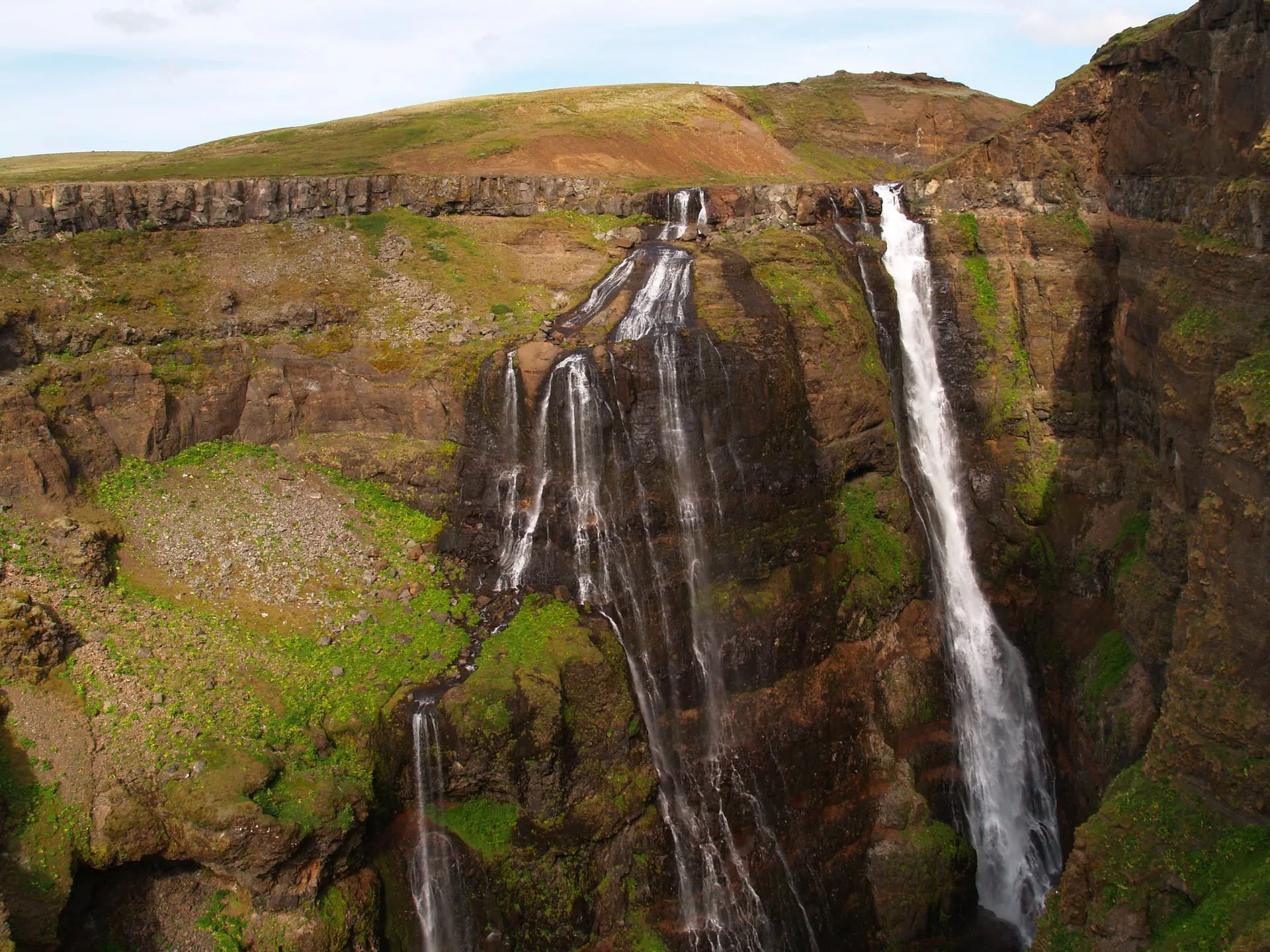
- Lush green and lupine. The landscape is at its greenest, with purple lupine fields through June and July.
- The warmest temperatures of the year (~13–15 °C) and whale watching at full capacity.
- Festivals. Jónsmessa (Icelandic midsummer, June 24 — see our Jónsmessa piece) and Verslunarmannahelgi / Þjóðhátíð on the first weekend of August.
What does summer take away?
- The aurora. Skies never get dark enough until late August; the northern lights are physically invisible no matter how strong the activity.
- Ice caves. Natural blue caves are a winter feature — they need the glacier frozen solid. Summer’s substitutes are a man-made ice tunnel or a glacier hike.
- Space and value. Summer is the annual peak for crowds and prices, and accommodation books out months ahead.
If your trip is about the aurora or ice caves, the season inverts — read Iceland in winter instead.
What is the driving reality in summer?
The paved network is the easy part. In summer:
- Route 1 (the Ring Road), the Golden Circle and the South Coast are all open, dry and straightforward. A 2WD car handles all of it.
- The Highland F-roads open on a staggered June schedule, not a fixed date. Easier passes like F35 Kjölur usually open late May to early June; Landmannalaugar (F208) and Þórsmörk (F249) typically mid- to late June; the remote interior — Sprengisandur (F26), Askja (F88) — often not until early July. Vegagerðin sets each date after inspecting the route, so check the live status the morning you drive.
- Any F-road requires a 4×4 — it’s a legal requirement and your rental insurance is void otherwise. River crossings need real care; defer to SafeTravel and road.is, not the calendar.
How do you plan a summer trip?
- Book early. Hotels and car hire hit their annual maximum and sell out — reserve 3+ months ahead in popular spots like Vík and Höfn.
- Pack for weather, not warmth. Summer is mild, wet and windy, not hot. Layers plus a waterproof, windproof shell — our summer packing guide has the full kit.
- Bring an eye mask. June and July never get properly dark; blackout sleep gear matters more than a head-torch.
- Aim for the late-August sweet spot if you can. You keep the summer-open roads and Highlands, gain the first aurora nights, and crowds and rates start to ease.
When does summer not suit you?
Summer is the wrong season if the trip is built around darkness. No aurora until late August, and no natural ice caves at all — both are winter signatures. If those are your reason for coming, Iceland in winter is the guide to read, and you’ll trade open Highlands and the midnight sun for ice caves, aurora and empty headline sights.
For the month-by-month detail, the summer trio sits in our by-month guides: June (puffin peak, Highlands opening), July (warmest, every road open) and August (the late-August aurora return).
See also
- Iceland in winter — the inverse season: ice caves, aurora and empty sights
- Iceland in June, July and August — the month-by-month detail
- Where to see puffins in Iceland — peak through mid-August
- What to pack for summer in Iceland — layers, not shorts
- When Iceland’s Highland F-roads open in 2026 — the live opening sequence
- 7-day Ring Road itinerary — the classic summer loop
- What to do in Iceland today — live conditions and ideas
Frequently asked questions
When is summer in Iceland?
Summer is roughly June, July and August, with usable shoulders in late May and early September. July is the warmest and most reliable; late August keeps the open roads but brings back dark-enough nights for the first aurora.
Can you see the northern lights in summer?
No. From late May to mid-August the sky never gets dark enough — the aurora may be active but is physically invisible. The first real chance returns in the last week of August. If aurora is your goal, come September to March instead.
Are the Highlands open in summer?
Yes — summer is the only season they are. The F-roads to Landmannalaugar, Þórsmörk, Sprengisandur and Askja open in stages from late May to mid-July as the snow melts, and most stay open through mid-September. You need a 4×4; check road.is before any F-road.
Do you need a 4x4 in summer?
Only for the Highlands. A 2WD car handles the entire paved network — the Ring Road, Golden Circle and South Coast — comfortably in summer. The moment you want to drive any F-road, a 4×4 is a legal requirement, not a comfort upgrade.
Can you do ice caves in summer?
Not the natural blue ones — those are a winter feature that depends on the glacier freezing solid, and tours run November to March. In summer the alternative is a man-made ice tunnel (Langjökull) or a glacier hike with crampons, which run all summer.
How crowded is Iceland in summer?
This is the annual peak. Iconic sites are busy from about 09:00 to 18:00 in July, and accommodation and car hire hit their highest prices and book out months ahead. Visit headline stops early or after 17:00, and reserve hotels and cars 3+ months out.
Is summer the best time to visit Iceland?
It's the best time for open roads, the Highlands, the midnight sun and the most reliable weather — but the worst for crowds, prices and anything that needs darkness. If your trip is about aurora or ice caves, winter is the better fit.